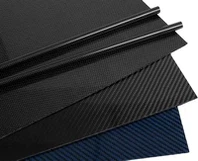
Lightweight, high-strength and rigid carbon fiber tubes can be used in a wide range of applications.
Carbon fiber tubes can replace steel and aluminum. In many instances, a carbon fiber tube can weigh 1/3rd of an aluminum tube and still have the same or better strength characteristics. Carbon fiber tubes are often found in applications where lightweight is crucial, such as industry, drones & UAVs, marine, medical, and sports.
Carbon Fiber Tubes Applications
Automotive
Carbon fiber is commonly used in automotive applications, from exterior components like hoods and spoilers to structural elements such as battery storage units in electric vehicles and passenger cells.
Drones & UAV
Provide the strength and lightweight constructural bodies, and increase performance
Marine
Carbon fiber is used in boat hulls, masts, and components due to its high strength and corrosion resistance, enhancing performance and durability in marine environments.
Civil Engineering
Carbon fiber reinforced polymers (CFRP) are utilized in infrastructure projects for strengthening bridges, buildings, and other structures, providing lightweight and durable solutions.
Oil & Gas
Carbon fiber composites are used in oil and gas applications for piping, risers, and platform structures due to their corrosion resistance and high strength-to-weight ratio.
Sporting Equipment
Carbon fiber is commonly found in sporting goods such as tennis rackets, golf clubs, and bicycles, offering enhanced performance through its lightweight and stiff properties.
Custom Carbon Fiber Tubes
1. Roll Wrapped Carbon Fiber Tube
Applied for producing high-quality composite tubes and cylindrical components that require high strength, lightness, durability, uniformity, and precision. This method involves wrapping prepregs carbon fiber or other composite materials around a mandrel, which is then cured to solidify the shape.
2. Filament Wound Carbon Fiber Tubes
For increased strength and properties in all directions, filament winding is an effective method in manufacturing carbon fiber tubes. Filament wound tubes are cost-effective and have excellent properties; however, the largest limitation is based on the length of the winding machine.
3. Pultruded Carbon Fiber Tube
Pultruded carbon fiber tubes are created by pulling linearly-oriented carbon fibers through a resin bath and then a series of heated tooling to create the specified inner and outer diameters of the tube. Carbon tubes are especially stiff longitudinally, due to the unidirectional orientation of the fibers. These tubes are stiff, lightweight composites that can be used in many applications, including robotics, aerospace, industrial equipment, and more.
4. Mold Pressing Octagonal, Square, Rectangular Carbon Fiber Tubes
Well-suited for producing high-volume, high-strength, and shaped tubes ( square, rectangular, hexagonal, octagonal and oval tubes), and complex parts from composite materials. This process involves placing a material, often preheated, into an open, heated mold cavity, then closing the mold and applying pressure to force the material into the shape of the mold. As the material cures or cools, it solidifies into the final part shape.
5. Autoclave Molding Long Carbon Fiber Tubes
Advanced manufacturing process is used primarily in the aerospace, automotive, marine, and sporting goods industries to create high-performance composite materials. This process involves applying heat and pressure within an autoclave (a pressurized, heated chamber) to cure composite materials, typically carbon fiber prepreg. Autoclave molding is used for manufacturing long square, rectangular, hexagonal, octagonal and oval carbon fiber tubes.
If you want to custom carbon fiber tubes for your project, please contact us for a quote.