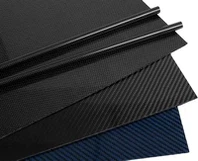
Carbon fiber has become the standard for high-performance drone frames and components due to its exceptional properties.
Why Carbon Fiber is the Preferred Material
The core requirements for a drone frame are high stiffness, low weight, and durability.
- Exceptional Strength-to-Weight Ratio: Carbon fiber is stronger than steel but significantly lighter.
- Longer Flight Times: Reducing the weight of the airframe allows for more battery capacity or longer flight duration.
- Better Agility and Speed: A lighter drone can accelerate and change direction more quickly.
- Increased Payload Capacity: Ability to carry heavier cameras (cinematic), sensors (mapping), or other equipment.
- High Stiffness (Modulus of Elasticity): This is critical for flight performance. A stiff frame:
- Prevents Flexing: Eliminates unwanted bending during aggressive maneuvers and under motor thrust.
- Reduces Vibrations: Minimizes the transfer of motor and propeller vibrations to the flight controller and camera, leading to stable flight and jello-free video.
- Improves Control: Provides a stable platform for the flight controller to operate accurately.
- Durability and Fatigue Resistance: Carbon fiber is robust and can withstand crashes and hard landings better than many materials. It doesn't bend permanently like aluminum; it tends to either survive intact or crack.
Common Carbon Fiber Drone Parts
Nearly the entire structural skeleton of a performance drone is made from carbon fiber.
- Main Frame Plates (Top & Bottom): The primary "chassis" that houses the flight controller, ESCs, and other electronics. These are typically cut from 1.5mm to 3mm carbon fiber sheets.
- Arms: These hold the motors and propellers. They can be:
- Integrated: Cut from the same plate as the main frame (a "true-X" or "stretch-X" design).
- Separate: Individual arms that bolt onto the main frame plates.
- Component Mounting Plates: Smaller, specific plates for:
- FPV Camera Mount: A sturdy, often adjustable plate for the front-facing camera.
- Action Camera Mount (e.g., GoPro): Designed to isolate the camera from vibrations.
- GPS/Compass Module: To keep it away from electromagnetic interference.
Carbon Fiber Drone Parts Trends
Advanced Composites: Hybridizing carbon fiber with materials like Kevlar for toughness.
Monoblock Designs: The entire frame is a single, molded piece for ultimate stiffness and weight reduction.
Application-Specific Designs: Frames tailored for racing, cinematography, or heavy-lifting, with optimized geometry and layup.
Additive Manufacturing: Using 3D printing with continuous carbon fiber to create complex, integrated parts.
For any serious drone application-whether for FPV racing, freestyle, or professional aerial photography-carbon fiber parts provide the unparalleled stiffness, light weight, and durability needed for optimal performance. While the cost is higher and careful installation is required to manage its electrical conductivity, the performance benefits make it the undisputed material of choice for the drone industry.