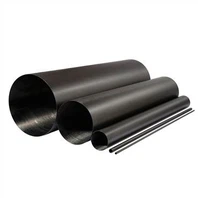
Xinbo Composites rectangular carbon fiber tubing is fabricated with unidirectional (UD), 3K twill and 3K plain carbon fiber prepreg by mold compression and autoclave process. Unlike metal tubing, carbon fiber tubing is designed with layers of fibers oriented at different angles to provide properties designed for a specific application.
Carbon Fiber Tubes Key Features
- High Strength to weight ratio: Carbon fiber tubes are 60% lighter than steel tubes of the same size and 30% lighter than light aluminum alloy tubes, allowing them to be widely used in robotics, high-precision mechanical machines, industries, and other applications.
- Dimensionally stable, excellent impact and fatigue resistance: Carbon fiber products are impervious to external impact deformation, and prevent permanent deformation during high-speed operation.
- Highly Corrosion Resistance: Metal pipes have high chemical activity and are generally easy to rust in the air. Carbon fiber pipes also have good corrosion resistance. They can maintain high stability in acid, alkali, and salt environments, and can be used for a long time to ensure safety and reduce the number of replacements.
- Thermally stable up to 140 degrees: Carbon fiber squares are formed and cured by high pressure and under 140 or 150 degrees, enabling tubes to have high-temperature resistance.
Carbon Fiber Rectangular Tube Manufacturing Process
The manufacturing process of carbon fiber rectangular tube roughly includes five steps:
1. Mold making
First, the mold is designed according to the customer's square tube dimension, including the tooling requirements after forming. In addition, a series of conditions of the carbon fiber square tube size should be considered, and the thickness of the reserved tolerance. To ensure dimensional accuracy, we should also pay attention to bending deformation. we must use a high-strength steel mold if the tube is large.
2. Prepreg cutting
After the mold is designed, the carbon fiber prepreg needs to be cut according to the size, the unidirectional carbon fiber prepreg needs to be stacked at 0 and 90 degrees, and the laying method needs to be determined according to the stress of the carbon fiber products.
3. Lay-up
The cut prepreg sheets are then carefully laid up layer by layer into the mold. The orientation and number of carbon fiber layers can be adjusted to achieve the desired strength, stiffness, and weight characteristics.
4. Vacuum Bagging and Curing
Once the layup is complete, a vacuum bag is applied to the mold and sealed. The vacuum bagging process removes air and ensures even pressure distribution during the curing process. The mold with the layup is then placed in an oven or autoclave, where heat and pressure are applied to cure the epoxy resin. This process solidifies the carbon fiber layers and forms the final part.
5. Demoulding
The carbon fiber square tube is taken out by the demoulding equipment. After demoulding, it is taken out and put into the molding machine. After demoulding, the mold needs to be cleaned before repeating the above steps.