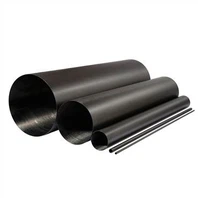
High-temperature resistant carbon fiber tubes are specialized composite structures designed to maintain their mechanical integrity and dimensional stability in environments where standard carbon fiber would degrade.
The heat resistance of a carbon fiber tube is determined almost entirely by the matrix (resin) rather than the carbon fibers themselves, as carbon fibers can withstand temperatures over 2000°C in inert atmospheres.
While standard carbon fiber tubes typically use epoxy resins that handle up to 80°C – 120°C, high-temperature variants utilize advanced resin systems to push those limits significantly higher.
Resin Systems
High-Tg Epoxy: Specialized epoxies with a high Glass Transition Temperature (Tg) can operate consistently at 150°C – 180°C.
Cyanate Ester: Offers excellent dielectric properties and thermal stability, suitable for 200°C – 250°C.
BMI (Bismaleimide): The industry standard for high-performance aerospace applications, capable of handling 250°C – 300°C.
Polyimide: Used in extreme conditions, these resins can withstand short-term exposure up to 400°C or higher.
Carbon Fiber Tubing Manufacturing Processes
The production of these tubes requires precise control to ensure the resin fully cures and achieves its maximum thermal potential.
Filament Winding: Continuous fibers are wound under tension onto a mandrel. This is ideal for pressure vessels or tubes requiring high hoop strength.
Roll Wrapping: Pre-impregnated ("prepreg") carbon fiber sheets are wrapped around a mandrel. This allows for complex fiber orientations (0° , +/- 45°, 90°) to optimize for bending and torque.
Press Molding: To achieve the high Tg required, these tubes are often cured under high pressure and temperature in an autoclave to eliminate voids and ensure high fiber volume fractions.
High-temperature resistant carbon fiber tubes are critical in industries where components must survive extreme heat without losing their shape or strength. Because carbon fiber is inherently "creep-resistant" (it doesn't stretch or deform under long-term stress), it outperforms most metals in high-heat, high-load environments.
Below are the primary applications categorized by industry and specific use case.
1. Industrial and Manufacturing
High-temperature tubes are often used to replace heavy steel or aluminum parts in factories to increase speed and precision.
Heat Treatment Furnaces: Used as rollers or support rods for moving parts through industrial ovens. Unlike steel, they won't warp or "sag" at high temperatures.
Robotic End-Effectors: In foundries or glass manufacturing, robotic arms use carbon fiber tubes to handle hot materials. The lightweight nature allows the robot to move faster, while the heat resistance protects the arm's structural integrity.
2. Automotive and Motorsport
In high-performance vehicles, weight reduction is vital, but many components sit near the engine or exhaust.
Exhaust Heat Shields: Tubes or half-tubes used to shroud exhaust systems, protecting sensitive electronic components from radiant heat.Turbocharger
Ducting: Carbon fiber tubes carry compressed, heated air from the turbo to the intercooler.
Drive Shafts: High-performance drive shafts can generate internal heat through high-RPM friction. High-Tg resins prevent the shaft from softening during prolonged high-speed runs.
3. Energy and Research
Hydrogen Fuel Cells: Used in the structural housing and piping where thermal management is a constant challenge.