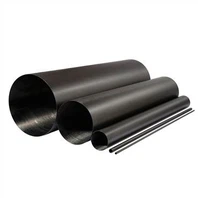
Caron fiber drive shafts are becoming more commonly used in automotive, commercial, defense, industrial and marine industries. Xinbo Composites customizes the lightest, strongest and highest RPM capability carbon fiber drive shafts for your project.
It's a precision process that requires years of experience and engineering expertise to fabricate carbon fiber drive shafts. Xinbo Composites uses these skills to develop and produce our industry-leading shafts. Through this proprietary carbon fiber weave or filament wound angle, we offer carbon fiber drive shafts with unmatched strength, reliability, and performance.
Carbon fiber drive shafts tend to be utilized in the most demanding and specialized fields because of their unique blend of capabilities, including:
1. More Torque
Independent testing by a trusted automotive periodical showed rear wheel horsepower increased by more than 5% with only the switch from a conventional steel driveshaft to a carbon fiber driveshaft. This is primarily due to the lighter rotational mass of the carbon fiber driveshaft. A lightweight carbon fiber driveshaft allows more engine power to be transferred to the wheels.
2. Higher RPM Capability
For a fixed diameter and length, a custom, engineered carbon shaft will have a higher critical speed than steel, aluminum and titanium shafts. This is due to the low mass density of the carbon fiber/epoxy and the relatively high axial stiffness of the engineered laminate. This results in a shaft that can operate several thousand RPMs higher than a metal shaft of the same diameter and length.
3. Lighter Weight
A lighter carbon fiber shaft increases your fuel economy and rotational mass, which, as mentioned earlier, increases torque. It also makes installation easier.
4. Increased Safety
Carbon fiber drive shafts are built for strength for torque transfer and can be broken with a hard blow from the side. The result is that when a u-joint or yoke fails, the carbon fiber composite begins to disintegrate when it contacts the chassis. As the composite comes apart, the shaft simply turns into a bunch of loose carbon fibers instead of tearing up the driver and vehicle.
5. Torsional Damper
For the same fixed diameter and fixed length, it is possible to engineer a carbon shaft to have a relatively low modulus of rigidity resulting in a shaft with a high torsional flexibility compared to the same size metal shaft. This unique characteristic will "smooth out" and absorb torque spikes of the engine extending the transmission life.
6. Greater Life Cycle
Carbon fiber drive shaft does not have any welds, there is no metal fatigue. The life cycle of a properly designed composite shaft will far exceed all types of metal shafts since carbon fiber composite has extraordinarily high fatigue strength. The typical fatigue failure location of metal shafts is in the weld area.
7. Lower Noise, Vibration and Harmonics
Due to the epoxy matrix of the composite material, the composite shaft has an inherent vibration-dampening characteristic. A smoother ride is easier on your equipment and easier on the operator. As a result, the carbon fiber drive shafts are subjected to less stress and tend to last longer. The same can then be said for the other components of your powertrain.
Let us know what your application requirements are and we would be happy to provide a quotation for your project. We will need the following information
• Seal-to-center dimension
• Maximum Operational RPM
• Maximum horsepower
• Transmission type
• Maximum Operational Torque
• Overall Length
• Maximum Outside Diameter
• Quantity Requirements